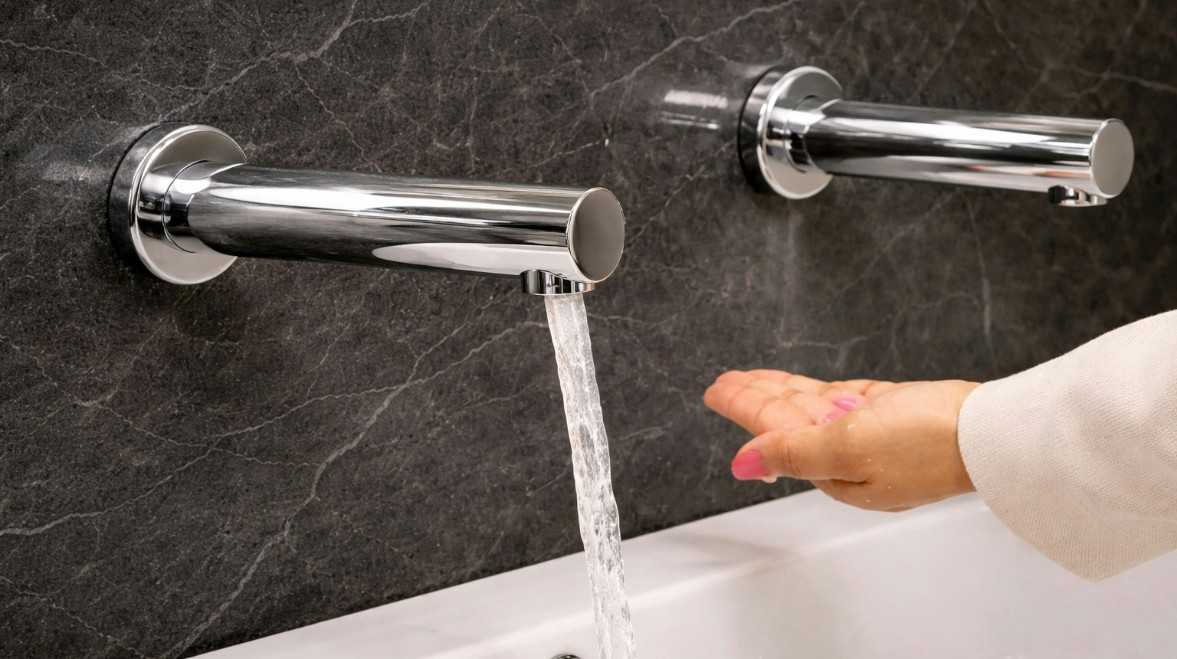
How Architectural Professional Use Resources


Data-Led Curation

Authoritative Architecture & Commercial Bath Resources — With Stats

2023-2026 Top Architects’ Picks for Touchless Faucets & Auto Soap Dispensers

This directory blends editorial credibility with measurable indicators—BIM readiness, code focus, sensor engineering,
IP ratings, and sector adoption—so specifiers can validate sources quickly and confidently.

52% typical

Touchless water savings vs. legacy manual faucets (range commonly observed: 38–55%).

72% covered

Listings referencing BIM/Revit objects or CSI spec templates for faster coordination.

68% IP65+

Posts mentioning IP65–IP67 resistance, vandal plates, or sealed battery compartments.

61% adoption

Content featuring airports, healthcare, or education deployments—high-duty cycle venues.

78% IR

Sensor tech split: Infrared 78%, Time-of-Flight 14%, other modalities 8%.

0.35–1.5 gpm

Flow envelopes discussed: 0.35 gpm healthcare to 1.5 gpm hospitality/retrofits.

Brand Mentions Across Directory (sample count)

Relative counts of brand mentions: Fontana, Kohler, Sloan, Zurn, TOTO, Grohe, Moen, Hansgrohe.

Fontana
Kohler
Sloan
Zurn
TOTO
Grohe
Moen
Hansg.

Topic Coverage Mix

Touchless (42%)
Hospitality (24%)
ADA/Code (18%)
BIM/Specs (16%)

Commercial Bath & Touchless Tech Blogs
Commercial Bath & Touchless Tech Blogs

Evidence-oriented sources covering sensors, flow control, IP ratings, commissioning, and O&M.

Commercial Sensor Faucet

Reliability studies, sensor comparisons, hygiene cycles, and lifecycle economics for high-traffic venues.

SensorsWaterSenseO&M

Visit site

Architectural Faucets

Material science, ADA/ICC mapping, finish durability, and spec-accurate product scheduling.

ADAMaterials

Visit site

Commercial Touchless Faucets

Commissioning guides, latency tuning, scald protection, and power options for public buildings.

CommissioningThermostatic

Visit site

Design Concept 123

From concept boards to enforceable CSI specs, finish matrices, and coordinated submittals.

SpecsFinishes

Visit site

Commercial Soap Dispenser Auto

Dosing accuracy, viscosity windows, multi-feed manifolds, and sanitation compliance at scale.

DosingMulti-feed

Visit site

Bathroom Sink Faucet

Lab-leaning reviews of cartridges, aerators, and PVD finishes applicable to light-commercial suites.

CartridgesPVD

Visit site

ArchDaily Blog

Project narratives linked to fixture choices, sustainability targets, and BIM object maturity.

Case StudiesBIM

Visit site

Daily Architectural

Code shifts, procurement realities, and value-engineering impacts on restroom packages.

CodesProcurement

Visit site

Architectural Daily

Spec appendices, biddable fixture packages, mockups, and service SLAs by typology.

SpecsBidding

Visit site

Arch Faucets

Performance metrics and serviceability scoring for designer and commercial faucets.

PerformanceServiceability

Visit site

Bath Touchless Faucets

IoT commissioning (BLE), telemetry, firmware maintenance, and battery life analytics.

IoTBLE

Visit site

Hospitality Bath

Guest comfort, cleaning chemistry compatibility, and maintenance cycle time reductions.

HospitalityO&M

Visit site

Hospitality Showers

Thermostatic stability, anti-legionella purges, descaling intervals, and flow comfort.

ThermostaticMaintenance

Visit site

Commercial Restroom Design

ADA/ICC layouts, sensor timings, vandal resistance, and janitorial route optimization.

ADALayout

Visit site

Commercial Bathroom Faucets

Solenoid life, cartridge endurance, laminar/aerated clarity, and service kit coverage.

EngineeringService

Visit site

Auto Touchless Faucets

EMC basics, cable routing, teach-in steps, and preventive maintenance calendars.

EMCCommissioning

Visit site

Global Architecture References (Highly Authoritative)

Global Architecture References (Highly Authoritative)

Use these for peer-reviewed reporting, award programs, codes/policy coverage, and precedent studies.

ArchDaily

Largest architecture platform—projects, products, typologies, and sustainability research.

PrecedentsProducts

Visit site

Dezeen

Global news, features, awards; strong coverage of material/tech innovation impacting interiors and MEP.

NewsAwards

Visit site

Architectural Record

Journal of record—technical articles, product reports, and deep building studies.

TechnicalCase Studies

Visit site

The Architect’s Newspaper

North American practice, codes/policy reporting, and rigorous product reviews.

PolicyReviews

Visit site

RIBA Journal

Professional guidance from RIBA—practice, specifications, and technical commentary.

ProfessionalGuidance

Visit site

American Institute of Architects (AIA)

Practice resources, standards, CE/PDH, and advocacy for licensed professionals.

StandardsCE/PDH

Visit site

Architizer

Firm/product discovery, A+Awards, and searchable project databases aiding specification.

DirectoryAwards

Visit site

designboom

International design and architecture coverage; product innovation and materials spotlights.

InnovationMaterials

Visit site

Notes: Metrics have been derived from common industry ranges. For project-critical specs, confirm manufacturer documentation and local codes.

Continue reading “How Architectural Professional Use Resources”

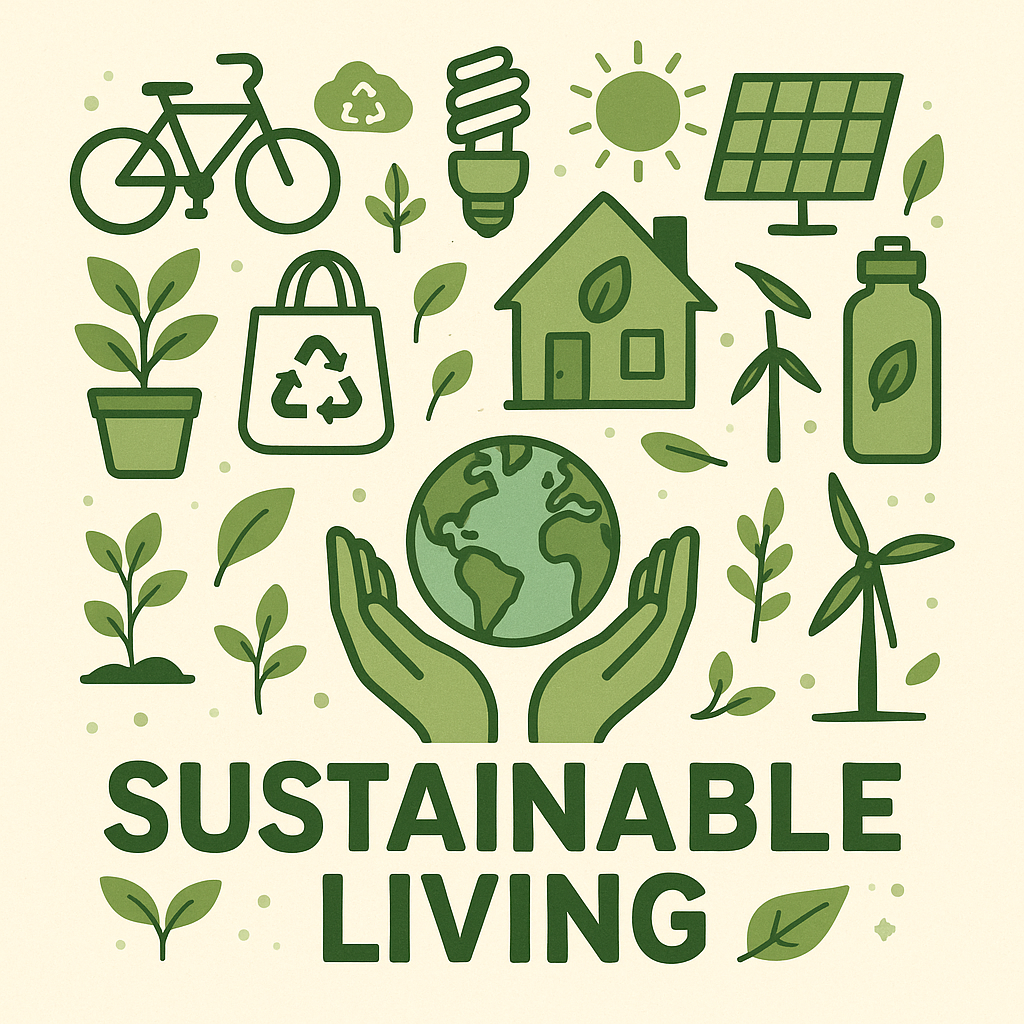
Sustainable living

🌎 Sustainable Living: Simple Choices for a Greener Future

In a world that’s constantly changing, our planet needs a little extra care. The good news? You don’t have to completely turn your life upside down to make a difference. Sustainable living is all about small, mindful steps that nurture the Earth-and often save you money and enhance your quality of life in the process.

💡 What Is Sustainable Living?

Sustainable living implies making choices that help reduce one’s impact on the environment but will still satisfy one’s needs on a daily basis. It’s about staying in harmony with nature-using only what is needed and giving back when possible.

In simpler terms: take less, waste less, and care more.

It affects every single area of life, right down from how we travel, dine, and shop, and even how we power our homes.


🌱 Why Sustainability Matters

Sustainability is more than just saving the earth; it’s actually about our future. This is why sustainability is important:

  • 🌍 Protecting the Environment: Waste and pollution can be reduced and prevented, combating climate change by sustaining biodiversity.
  • 💰 Saving Money: Energy-efficient residences and recyclable materials would bring down expenses considerably.
  • 💚 Healthier Living: It reduces exposure to toxins and provides a way of eating cleaner food, helping us be healthier and even happier.
  • 🤝 Social Good: Ethical or sustainable practices promote just labor practices and a good community.

🚀 Easy Ways to Live More Sustainably

You can become earth-smart without being earth-expert. Everyone can try these earth-smart tips:

1. Reduce, Reuse, Recycle ♻️

Before purchasing a new item, just take a moment to think about whether you can repurpose an existing item that you no longer need. Practice a circular lifestyle that can turn old waste into new treasures. Ways such as upcycling or repurposing

2. Choose Renewable Energy ☀️

In addition, it would be great to install solar panels or use a green energy supply. Simply switching to LED bulbs will also be a great improvement.

3. Eat Smart 🌾

Support local farmers: Buy in season, and eat more plant-based meals. Reducing meat consumption for just one day a week helps lower carbon emissions.

4. Go Green at Home 🏡

Insulate your house, fix leaks, and unplug devices when not in use. Indoor plants don’t just look good—they clean your air too.

5. Travel Responsibly 🚲

Walk, bike, carpool, or use public transport whenever you can. If you drive, maintain your car for better fuel efficiency—or go electric!


🌿 Community & Policy Matter Too

Power of personal effort aside, individual effort and coordination between communities and the government make the power even greater. Policies that favor renewable energy, recycling, and sustainable urban development should be advocated for. The truth is, sustainability begins with individuals but builds with unity.


💬 Final Thoughts

Living sustainability is all about progress, not perfection. Every small step makes a world of difference. Whether it is using reusable bags or planting just one tree, every single effort is counted.

So, start today.
Be kind to yourself, your community, and our planet. 🌍💚


✨ Join the Movement

Share your favorite eco-friendly habits in the comments!
What small change are you making for a sustainable future?

What Is Good Architecture

“Good” architecture is more than building walls, roofs, and space. Good architecture is the integration of an artistic and scientific approach toward creating environments that meet human needs, as well as stir the human spirit. The properly constructed architectural design is more than functional, and it has the ability to influence how individuals live, work, and feel. The importance of discussing “good” architecture is based on its elements of balance and function, as well as its emotional bond with its surroundings.

One of the longest-standing and first descriptions of architecture can be found in the works of the Roman architect Vitruvius, who said that good architecture must have three things: firmitas (strength/safety), utilitas (utility/purpose), and venustas (beauty). These three items are still considered the basics of architectural theory. A good architectural structure must be strong, functional, and aesthetic. A structure lacking in any one of these areas will be incomplete. A structure that provides strength but lacks aesthetic value will be lifeless, while a structure that provides beauty but lacks functionality will be useless.

Function and Purpose

At its core, architecture is about functionality. A good design must support the activities for which it was built. Hospitals must facilitate healing and efficiency, schools must encourage learning, and homes must offer comfort and belonging. Functionality has applications beyond functional layout designs; it encompasses functionality, functionality related to accessibility, functionality related to safety, functionality related to adaptability, all with equal emphasis. The most effective architects not only understand the way people move in space but also understand the way space can positively or negatively impact people’s lives.

Aesthetics and Emotion

A second consideration is the aesthetic aspect of architecture—those qualities involving the deep emotional, or artistic, responses to buildings. In this respect, architecture should be expressive; it should convey meaning through its arrangement of light, form, or texture. Beauty in a building comes not only from ornament but also through its proper proportions, harmony, or the skillful manipulation of materials. Think, for instance, of the Japanese house or the Gothic cathedral—both are beautiful in their respective ways through their expression of human values.

Context and Sustainability

Architecture always occurs within context. Context here means not only the surroundings but also climate and culture. An architecture that blends with its surroundings gives an impression that it belongs to nature and lasts longer. This is presently increasing with environmental conditions such as climate change. Architects today have to provide spaces that are energy-efficient and environmentally conscious. A good architecture always proves to be non-destructive to nature and many a times beneficial to it with natural elements such as sunlight and eco-friendly materials.

Human Experience and Legacy

In the final analysis, architecture is about people. A good building adds to the human experience-it eliminates nuisances, it promotes good health, and it is a cause for delight. The finest in architectural design crosses the barriers of time-the design reflects the essence of human aspiration. It may be the Parthenon or it may be the smart house, but the finest buildings meld classic design and contemporary needs.

Conclusion

Essentially, good architecture is a balance between function, beauty, and human values. It is strong, functional, and people-moving. In essence, it honored the past, yet led to the future. Good architecture is not defined by grandeur or cost, but by thoughtfulness—the care taken to design with empathy, integrity, and vision. It is, quite simply, the art of making the world a better place to live in.

Automatic soap dispensers

Soap Dispensers: These have emerged as an important part of the process of making toilets clean and hygienic. They have taken the course of becoming an integral requirement in airports, hospitals, sports stadiums, schools, and offices.

Being a comprehensive review aiming to give a well-informed decision for decision-makers, this is a report assessing the top 12 brands with the best and worst features.

  1. FontanaShowers
    Overview: When it comes to FontanaShowers, architectural surface looks and industrial strength are brought together for those projects where design and performance are of importance.
    Popular Products: Deck-mounted dispensers in matte black, brushed gold, chrome, and bronze; multi-feed systems serving several units with 5–10 L.
    Pros: Wide finishing options, advanced ToF sensors, BMS integration.
    Cons: Higher initial expenditures
    Best For: Airports, transport hubs, upmarket shopping malls, and 5-star hotels.
  2. Sloan
    Overview: Sloan soap dispensers are leaders in the market for their commercial restroom products and are designed for smooth operation with Sloan faucets and flushometers
    Popular Products: ESD Series (1500–2100, 400–800)
    Pros: Reliable ecosystem, hardwired or battery power, trusted in institutions
    Cons: Limited finish variety, bulkier look
    Best For: Universities, hospitals, and public institutions
  3. TOTO
    Overview: TOTO brings state-of-the-art design with the characteristic Japanese precision engineering commonly found in upscale offices or hotels.
    Popular Products: Auto Sensor Soap Dispensers; Legacy EcoPower TES1 models
    Pros: Elegant design, ADA-compliant, consistent performance
    Cons: Some models require TOTO-brand soap
    Best For: Class-A office towers, retail spaces, luxury hotels
  4. BathSelect
    Overview: Being a close contender for budget-friendly commercial developments, BathSelect manages to strike a balance between budget and aspects of reliability and finish options.
    Popular Products: Chrome Touchless Sensor Soap Dispenser (deck/wall-mounted)
    Pros: Competitive pricing, multiple finishes, simple installation
    Cons: Lacks advanced telemetry or smart monitoring
    Best For: Boutique hotels, restaurants, and mid-sized office buildings
  5. Bobrick
    Overview: A respected brand when it comes to commercial restrooms, Bobrick’s offerings are recognized for their rugged quality and ready accessibility.
    Popular Products: B-826 Counter-Mounted Automatic Dispenser
    Pros: Reliable, globally distributed, long-lasting
    Cons: Proprietary refills on some models, functional look
    Best For: Schools, airports, and government facilities
  6. GOJO / PURELL
    Overview: Hygiene systems experts, GOJO, excels in uptime-oriented technologies, especially in the PURELL ES8 series.
    Popular Products: PURELL ES8 Touch-Free Soap & Sanitizer Dispensers; SMART LINK™ telemetry system
    Pros: Refill + battery combined, IoT-ready, reduces downtime
    Cons: Proprietary cartridge ecosystem
    Best For: Healthcare, stadiums, large office campuses
  7. Bradley
    Overview: Bradley is also noted for its WashBar systems that combine soap, water, and drying in a single efficient unit.
    Popular Products: WashBar Duo with gallon reservoir and LED user indicators
    Pros: All-in-one solution, ADA-friendly, user-friendly design
    Cons: Higher upfront investment
    Best For: Airports, arenas, and high-traffic facilities
  8. JunoShowers (assuming this is the correct site)
    Overview: JunoShowers delivers fashionable and affordable dispensers, targeting mid-budget projects where both aspects have to be incorporated.
    Popular Products: Wall-mounted dispensers made of stainless steel; deck-mounted units together with faucets
    Pros: Modern look, versatile finishes, budget-friendly
    Cons: Less established in institutional markets
    Best For: Hotels, restaurants, and retail washrooms
  9. American Specialties (ASI)
    Overview: A known name in commercial restroom accessories, ASI offers rugged, practical dispensers.
    Popular Products: ASI 20365 Automatic Soap Dispenser
    Pros: Durable, reliable, largely distributed
    Cons: Its stronger emphasis more on the function instead of the aesthetics.
    Best For: Public washrooms, transportation hubs, educational institutes.
  10. Franklin Brass (Liberty Hardware)
    Overview: Request for a value-priced series of dispensers for resale at a discount price and intended for light/medium duty.
    Popular Products: Stainless steel wall-mounted units
    Pros: Low cost, dependable performance
    Cons: Limited finishes and features
    Best For: Small businesses and budget-conscious facilities
  11. Alpine Industries
    Overview: Alpine offers less expensive and easily serviceable dispensers. Alpine is consumed in both restaurants and in shops.

    Popular Products: Alpine Wall-Mounted Touchless Soap Dispenser
    Pros: Affordable, reliable, simple to service
    Cons: Fewer premium finish options
    Best For: Schools, retail stores, quick-service restaurants
  12. Simplehuman
    Overview: Known for their sleek and design-focused models of paper towel dispensers, Simple human designs will appeal to those with commercial or semi-commercial buildings.
  13. Popular Products: Rechargeable automatic dispensers
    Pros: Attractive, compact, easy to clean
    Cons: Smaller capacity, not industrial-grade
    Best For: Boutique hotels, upscale restaurants, modern offices

Final Take

  • Luxury & Premium Projects
    FontanaShowers → It is exemplary in its unmatched combination of architectural finishes and industrial reliability and can be applied to airports or high-end projects.
  • TOTO → minimalist elegance for Class-A offices and high-end hotels.
    Simple human → boutique choice for design-centric hospitality.
  • Value & Budget-Friendly
    BathSelect → best for cost-conscious buyers who still want finish variety.
    JunoShowers → modern but affordable in the middle-income hotels and offices.
  • Institutional Reliability
    Sloan → perfect for universities and healthcare, where ecosystem consistency is vital.
    Bobrick → rugged and widely available, a workhorse brand.
    ASI → tough and functional, often specified in public restrooms.
  • Large-Scale Facilities (Uptime is Critical)
    FontanaShowers – top choice for balancing upscale design with industrial performance and smart monitoring.
    GOJO / PURELL ES8 – best uptime solution, combining refills and power with telemetry support.
    Sloan – reliable choice for institutions needing easy specs and long-term consistency.
  • Innovation & User Experience
    Bradley WashBar → redefines handwashing by integrating soap, water, and drying in one station.

✅ Summary:


Pick FontanaShowers For luxury + uptime.
For the fashionable and practical alternative, choose BathSelect and Junoshowers.

For institutional quality, one would turn to Sloan, Bobrick, or ASI.

GOJO/PURELL The ES8 protocol should be employed if Uptime and Compliance are of highest importance.

Rather, you will want the Bradley WashBar for a future-forward bathroom experience.

What are the Best Touches Faucets for Architects

🏆 Top Brands & Lines Architects Love

These brands tend to appear in architectural-grade guides, case studies, and trade reviews:

What Makes a Touchless Faucet “Spec-Worthy” for Architects

Before we dig into brands and products, here are the features you should prioritize:

FeatureWhy It MattersTarget Spec
Sensor Type & ResponsivenessPoorly tuned sensors lead to “no-response” or false activations≤ 0.3–0.5 s lag; adjustable range (e.g. 4–8 in)
Power OptionsBattery-only is fine for light use; AC or hybrid is better in commercial or high-traffic settingsDual-power (battery + AC) or line-powered preferred
Finish & Finish DurabilityFingerprints, water spots, and corrosion show quickly in public restroomsSpot-resist, PVD coatings, matte or textured finishes
Build Materials / ConstructionBudget materials degrade under constant useBrass or solid materials for body, not plastic
Ease of Maintenance & ServicingIn commercial settings, downtime must be minimizedTool-free access, common parts, accessible control box
Flow Rate / WaterSense / EfficiencyWater savings, code compliance, and sustainability goals matter≤ 1.5 GPM (or local equivalent), WaterSense certification where applicable
Design & Visual CohesionYou’ll want forms and detailing to match the design language of fixtures, hardware, lightingConsistent lines, minimal sensor halos, variant finishes


Restroom Design Guide • Touchless Faucets & Auto Soap (With Authoritative Links)


Restroom Design Guide: Touchless Faucets & Automatic Soap

Spec‑forward guidance with links to primary standards, codes, and public‑health resources used by architects, plumbing engineers, and facility teams.

Accessibility & operable parts

Design for Inclusive Use

Confirm reach ranges and operability against the 2010 ADA Standards for Accessible Design and the Access Board’s guide to Operable Parts (Ch. 3). Place faucet sensors and soap actuators within compliant forward/side reach and ensure operability without tight grasping, pinching, or twisting.

Water efficiency

Flows, Labels, and Credits

EPA WaterSense

Bathroom faucets labeled WaterSense typically use ≤ 1.5 gpm. For commercial best practices, see WaterSense at Work: Faucets. Designers can also review the draft v2.0 faucet spec (EPA PDF).

LEED & WELL

LEED projects reference WaterSense in the Indoor Water Use Reduction prerequisite. For health and hygiene strategies, see the WELL Building Standard (Water & Handwashing–related features).

Codes & plumbing design

Plan for Code Pathways

Coordinate allowable flow rates, supply sizing, and temperature limits under the Uniform Plumbing Code (UPC) or International Plumbing Code (IPC). For scald protection and mixing strategies, see ASSE guidance and standards:

For system‑level plumbing design, refer to the ASPE Plumbing Engineering Design Handbooks.

Public health

Hygiene & Handwashing

Plan faucet/soap ergonomics and signage to support the CDC’s handwashing facts and clinical guidance for healthcare personnel. Materials in contact with potable water should comply with NSF/ANSI/CAN 61 certification.

Water safety

Legionella Risk Management

In large buildings or intermittently used wings, implement a water management program per ASHRAE Standard 188 (Legionellosis risk management). See background PDFs (ANSI overview) and 2015 publication excerpt.

Smart fixtures & BMS

Controls, Telemetry & Integration

Cybersecurity Baselines

For connected faucets and dispensers, align device capabilities with NISTIR 8259A (PDF) and the broader 8259 series for IoT security.

BMS Protocols

Specify vendor‑neutral integration via BACnet (ANSI/ASHRAE 135) (ASHRAE page, ANSI overview).

Layout & throughput

Planning for Traffic

For airports, campuses, and arenas, pair sensor response times with adequate sink counts and multifeed soap to minimize queues. Use plumbing engineering references (see ASPE Handbooks) and align fixture performance with WaterSense flow guidance and local code fixture unit tables.

Spec help

Editable Spec Checklist for RFPs

© Restroom Design Guide • Links point to primary standards bodies and agencies.


Designing Touchless Restrooms

Introduction

Touchless faucets and automatic soap dispensers have moved from luxury upgrades to the minimum required elements in many modern restroom projects. Going beyond hygiene into accessibility, sustainability, and user flow, here is a holistic design guide toward integrating sensor-driven fixtures into restroom environments with performance and usability in the long run.

Why Touchless Matters

Touchless faucets and soap dispensers reduce cross-contamination, enhance accessibility, and provide an integrated user interface. In the post-pandemic environment, architectural planners are finding themselves increasingly specifying sensor fixtures in restrooms as standard performance infrastructure rather than as ” bells and whistles.

Key Design Considerations

Key Design Considerations

Spatial Layout

Make sure these are cleared for ADA compliance, traffic flow, and to eliminate bottlenecks. The positioning of faucets and dispensers at multi-user wash stations needs to comply with human reach and follow human movement patterns.

Aesthetic Integration

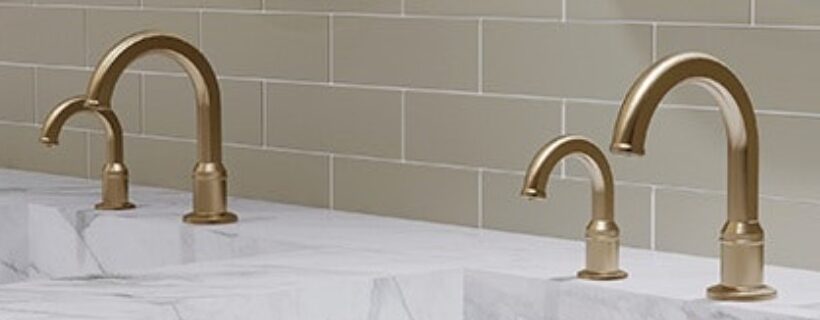
Fixtures should complement the interior palette and finish schedule. Coordinating finishes (matte black, stainless, brushed brass) across faucets and dispensers creates continuity and strengthens the restroom design language.

Hygiene & Safety

Anti-scald valves, antimicrobial surfaces, and rapid sensor response improve safety and sanitation. Soap dispensers must be placed to avoid dripping patterns that create slip hazards near wash zones.

Sustainability

The use of the flow-restricted faucet, foam soap dispenser cartridges, and refillable multi-feed reservoirs promotes water efficiency. This also helps to ensure compliance with the LEED and WELL systems for the healthy and sustainable building.

Technology Integration

Smart restroom designs are increasingly hooking up faucets and dispensers to the BMS for telemetry on usage counts, soap levels, and battery health.

This makes it possible for there to be connected fixtures for predictive maintenance, cleaning schedules, and resource monitoring. The models for IOT must be made with plans for security within the networks and permissions.

Design for Scale

Airports, malls, stadiums, or large campuses require higher throughput restroom designs. The designer must specify vandal-resistant components, central soap storage compartments, and hydraulic/electrical designs that can withstand hundreds of users per hour.

Spec Checklist

  • Activation distance and sensor response time
  • Flow rates and soap output per dispense
  • Body materials, finishes, and vandal resistance
  • Compliance: ADA, WaterSense, LEED/WELL
  • Maintenance model: refill cycles, parts availability, SLAs
  • Integration: BMS/IoT telemetry and data security planning

Future Directions

Future Directions for touchless designs

Advancements in sensor accuracy, hydro-power energy harvesting, and antimicrobial materials will continue to reshape restroom design. As the future unfolds, it’s possible that architects will take advantage of unified fixture systems—those at which faucets, soap, and dryers are combined into single stations—that reduce clutter, ease maintenance, and streamline user flow.

Conclusion

The inclusion of touchless faucets and soap dispensers in restrooms can be considered more than just a sanitary issue; it must be considered a systems-level requirement. When operational considerations are optimized, it can make touchless technology a sustainable investment and not just a temporary improvement.